Posts

Showing posts with the label NEWS

REPRESENTATION OF THERESA MAY
Image
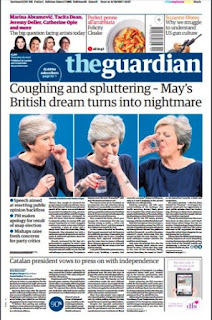
E.g.  E.g. E.g.  The examples above, all represent Theresa May in a negative light, no matter the political ideology of the newspaper. Firstly, The Guardian, a left-wing liberal paper, is often unsupportive of May due to contrasting political beliefs. Even so, the images of the prime minister which have been used on this front over are unflattering; hence, taking the attention away from the importance of the speech she was involved in, and placing it on her 'coughing and spluttering' instead.  Secondly, City A.M.'s front cover focuses on May's loss  
REPRESENTATION & POLITICAL IDEOLOGIES

Image
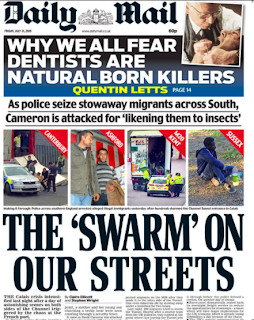
To what extent do the elements of media language used in source A & B convey different values, attitudes and beliefs about the world? Source A Source B In the two given sources, they both convey two very different angles on the EU's refugee crisis. Firstly, the Daily Mail's approach to this news shows how the papers low-brow agenda dehumanises the refugees who have traveled into the country, labelling them as if they were insects, 'the swarm'. However by reading further into this front page, the subheading states that the prime minister, 'Cameron', referred to the UK's migrants as if they were insects. Furthermore, even though the Daily Mail didn't make this dehumanisation originally' the way in which the paper has chosen to present the coverage still comes across as if they agree with this opinion.  In source B, the Guardian deliverers an opposing view on the news story. The paper uses an emotive but realistic...

COMPARISON ANALYSIS OF POLITICAL IDEOLOGIES

Image
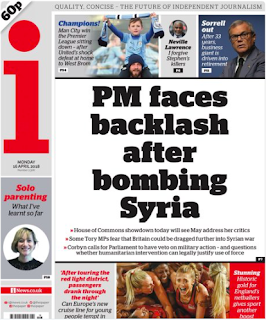
Here, the examples above show an example of a tabloid paper, (The Daily Mail), and a broadsheet paper, (The Independent), both covering the events which have occurred in Syria. These front cover pages are from the same date, hence the analysis of the two papers can be compared directly. One element of these two examples is a major factor in the influence of how the information is portrayed; the papers political stances shine through the headlines, effecting all aspects of these front covers.  Firstly, focusing on the paper brands themselves, their political stances are clear. The Daily Mail is a middle-market right-wing paper, therefore the opinion in this front cover can be easily presumed. The Daily Mail is typically supportive of conservative values, and hence any decisions made by Theresa May are often placed in a positive light. For instance, in the example above the masthead reads 'TRUMP: MISSION ACCOMPLISHED'. The Syrian airstrikes have been supported by three...

HOW DOES THE POLITICAL CONTEXT IN WHICH NEWSPAPERS ARE PRODUCED INLUENCE THEIR OWNERSHIP AND REGULATION?

Image
Explain the political significance of the concept of 'press freedom' and its relationship to representative democracy. Why do you think freedom of the press is important? How much influence do you think the government should have about the things reported in the UK press? I personally feel that the use of a free press has both positives and negatives, and therefore shouldn't be totally self-regulated. The invasion of privacy of those in the public eye is becoming more common, with reporters taking stories too far and gaining private information. This is happening due to the demand the readers give, responding well to stories that seem exclusive. However, I feel that when a scoop is no longer I the publics interest then it shouldn't be printed and hence should be regulated, as reporters are gaining both unwanted information and information which is too invasive. The concept of 'press freedom' has political significance as newspapers are able to support any po...

THE PARADISE PAPERS ONLINE

E.g. Twitter readership figures tone of comments from readers - political ideology? mail vs guardian how many times has the story been shared?

COMPARING THE UNSEEN ADVERTISMENT BY AMNESTY INTERNATIONAL TO SHELTER'S CAMPAIGN

Image
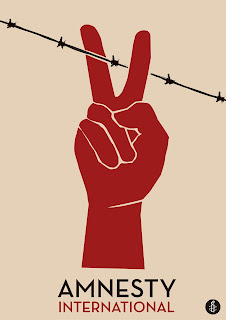
How have the creates of the advertisements created meaning through the use of Media Language? This advertisement by Amnesty International, a charity fighting for human rights across the globe, uses the contrast between peace and war to represent how they feel societies should be transformed. This opinion on creating equal and fair human-rights for everyone is clearly depicted in this advertisement. The main image used, a red hand showing a peace symbol holds the audiences main focus. The use of the colour red contrasts with the beige background, possibly referring to how supporters of Amnesty International can stand out and make a difference. This use of a peace sign in the advertisement is effective as it is a well-known across the globe, with the audience understanding its meaning without having toad in text or explanation. The size of this image is also relevant as, within the poster, it is the largest aspect. This may have been used to link in with the charities...

THE PARADISE PAPERS CASE STUDY

Image
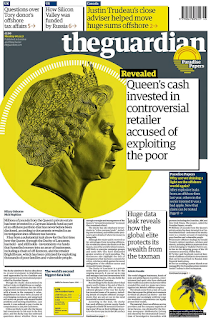
E.g. The Guardian Media Language On this Guardian front page, covering the first release of the story on the Paradise Papers, there is a clear colour theme. The use of a bright and bold colour like yellow makes the story stand out compared to the usual monochrome front cover page; this use of yellow could represent the gold colour of money or the sun in 'paradise'. The colour is repeated throughout the articles within the front page, helping to highlight the main elements and images. This use of smaller articles at the bottom of the page help to back-up the main article, providing readers with a deeper understanding of the topic by including related articles, almost like evidence for their viewpoint. As well as this, the overall layout of the paper is easy to take-in, with each aspect spread-out so to make sure the front cover page doesn't look crowded. Though the editor has still  made sure to include a large amount of copy at the bottom of the page, using th...

THE PARADISE PAPERS STORY COVERAGE

Image
On Monday 6th November, the main headlines across nearly all the national newspapers covered leaked documents revealing the financial details of the super-rich. These stories outlined how many were allowed to keep money in off-shore locations in order to avoid paying taxes. E.g. The Guardian This front cover page which the Guardian produced on Monday 6th November, covering the story E.g. The Mail  

NEWSPAPER OWNERSHIP & REGULATION

Image
E.g. The Barclay's Brothers Press Holdings The Daily Telegraph The European The Scotsman Sunday business E.g. News Corporation, Chairman & CEO Rupert Murdoch The Times The Sun  E.g. Scott Trust Limited The Guardian The Observer E.g. Lord Rothermere's Daily Mail & General Trust plc The Daily Mail E.g. Richard Desmond's Northern & Shell Daily Express Daily Star E.g. Trinity Mirror Daily Mirror Leicester Mercury E.g. Alexander Lebedev & Lord Rothermere London Evening Standard E.g. Daily Mail & General Trust plc Metro Within the UK's media ownership there may be concern as there is a small number of major businesses who own multiple media companies each, narrowing the range of opinions that are published. This isolation of power represents wealth rather than knowledge; therefore at the expense of quality and creativity. Similarly, this links in with the idea of London centric, where the majority of media pr...

THE IMPACT OF TECHNOLOGICAL CHANGE ON NEWSPAPERS

Image
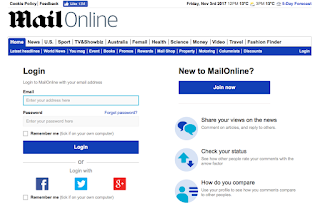
  A 'paywall' is the use of restricting access to internet content via a paid subscription. Newspapers began the use of a 'paywall' n 2010, helping to protect their revenue and profits as, what is now known as 'old media' is declining. More people are viewing their news online, therefore companies have had to accommodate to this change by adding a fee for viewers to look at full articles. E.g. The Daily Mail When looking at The Mail Online, viewers are able to read through hundreds of stories without hitting the 'paywall'. Though there is an option to 'log in, this allows users to comment on articles, also being able to look at how their comments compare to other users. As well as being able to have a Mail Online account, users can also subscribe. Here, this allows readers to access extra  information which users who use the standard website don't see. For example, the Daily Mail provides promotion subscriptions wher...

COMPARING EDITORIAL COMMENTS

Image
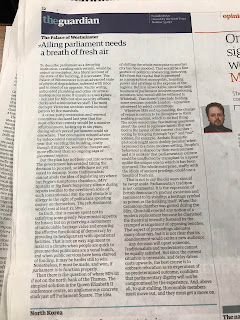
The Guardian The Daily Mail Similarities Both articles use a small masthead, this helps the reader to identify the editorial comment section easily, and helps to separate it from the rest of the articles in the newspaper. Both also choose to write their articles in column style, all text based, with no images to accompany it. As well as this, both newspapers use an authoritative and persuasive tone; this helps the publisher to get their point across to their readers, spreading their opinion. Though, in either newspaper, this doesn't come across as too upfront  as the readers of each newspaper already agree with the ideologies of the paper.  The editorial comments in both newspapers use subheadings, these are shown separate to the rest of the copy, helping to outline the opinion of the following article. Similarly, all the comment sections which the Daily Mail and the Guardian write are on current affairs. This appea...